

Architecture
Designing a Modular Merchant Services Platform
How shared capabilities and clear module boundaries help growing platforms—and the teams behind them—change with confidence.
Good architecture isn't about today's features. It's about tomorrow's possibilities.
Every growing platform reaches a point where adding a new feature becomes slower than building the previous one.
That isn't because engineers become less productive. It's because the architecture gradually starts carrying the weight of every decision made before it.
A shortcut taken to launch one feature becomes a dependency for the next. Similar functionality gets implemented in different places. Teams begin modifying the same code for unrelated requirements. Over time, adding a small capability feels disproportionately expensive.
This is a natural stage in the evolution of any successful product.
The question is not whether complexity appears.
The question is whether the architecture is prepared for it.
From Features to Shared Capabilities
One of the biggest mindset shifts in platform engineering is moving away from building features and towards building capabilities.
A feature solves a specific business requirement.
A capability provides a reusable foundation that multiple features can build upon.
Authentication, identity, notifications, transactions, reporting, permissions, and support are not simply individual features—they are shared capabilities that enable many different experiences across the platform.
When these capabilities have clear responsibilities and well-defined boundaries, new products can be introduced without constantly reshaping the rest of the application.
Boundaries Make Change Safer
As applications grow, boundaries become more valuable than clever implementations.
Clear module boundaries answer simple but important questions:
- What problem does this module own?
- What information should it expose?
- What should remain private?
- Which components depend on it?
When these answers are clear, engineers spend less time understanding the existing system and more time building new functionality.
Good boundaries reduce the impact of change.
Instead of every update affecting the entire application, changes remain largely confined to the capability they belong to.
Modularity Shapes How Teams Work
Software architecture influences how teams work just as much as it influences how software runs.
When responsibilities are clearly separated, teams can make decisions independently, test their work with confidence, and release improvements without coordinating every change across the entire platform.
Ownership becomes clearer.
Reviews become more focused.
Knowledge becomes easier to share.
In many cases, modularity improves communication as much as it improves code.
Choosing the Right Level of Modularity
Modularity is not a goal in itself.
Breaking an application into too many modules can introduce unnecessary complexity. Shared dependencies may quietly recreate the tight coupling they were meant to eliminate, and excessive abstraction can make simple changes harder instead of easier.
The objective is not to maximise the number of modules.
It is to minimise unnecessary dependencies.
Good architecture finds the balance between separation and simplicity.
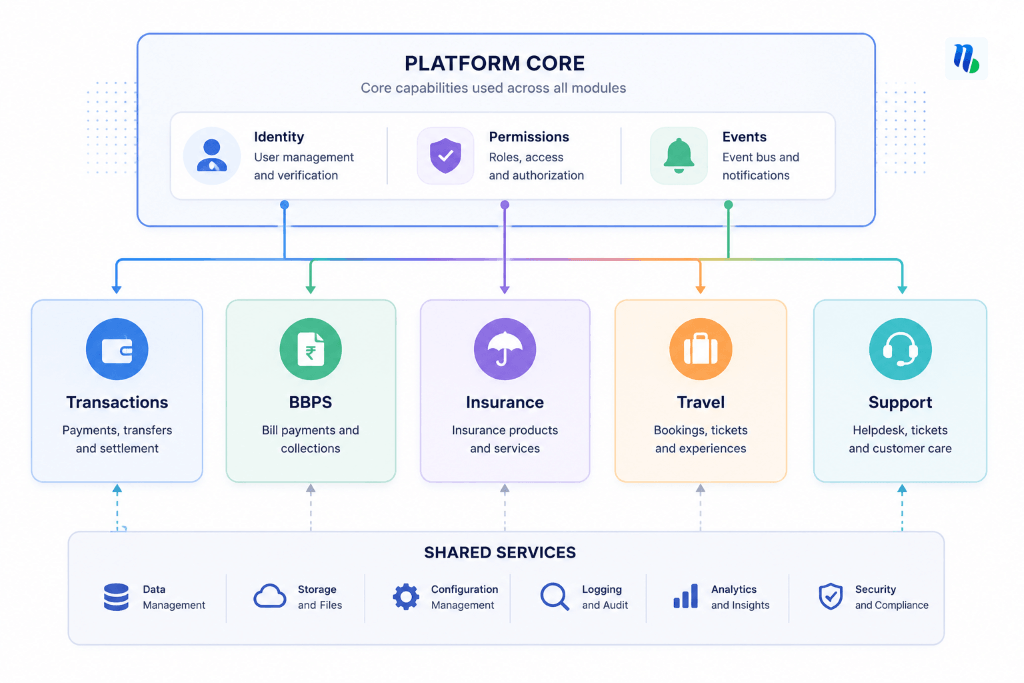
Designing a Platform That Can Evolve
Every platform continues to change.
New financial services are introduced. Regulations evolve. Customer expectations shift. Partners require new integrations. Engineering teams grow.
A modular architecture acknowledges that change is inevitable.
Rather than resisting it, the platform is designed to accommodate it.
That is why modularity is ultimately less about today's codebase and more about tomorrow's engineering decisions.
Because the best architecture is not the one that supports the most features today—it is the one that makes the next feature easier to build.