

Reliability Engineering
Supporting Retailers in Low-Connectivity Areas
How lightweight workflows, clear transaction states, and intelligent recovery build trust when connectivity is unreliable.
A payment shouldn't fail simply because the network did.
For many retailers across India, connectivity is not constant. A merchant may be processing a bill payment over a 3G network, travelling between towns, or operating in an area where signal strength changes throughout the day. While consumers often assume digital services are always online, reality is far less predictable.
Designing financial products for these environments requires more than faster APIs. It requires systems that remain understandable, resilient, and trustworthy even when connectivity does not.
Connectivity Is Part of the Product Experience
A retailer's work doesn't stop because the network slows down.
During a typical day, they may experience:
- High network latency
- Temporary connection loss
- Interrupted uploads
- Delayed transaction confirmations
- Entry-level Android devices with limited memory
- Customers waiting at the counter
Engineering decisions should begin with these realities rather than ideal conditions.
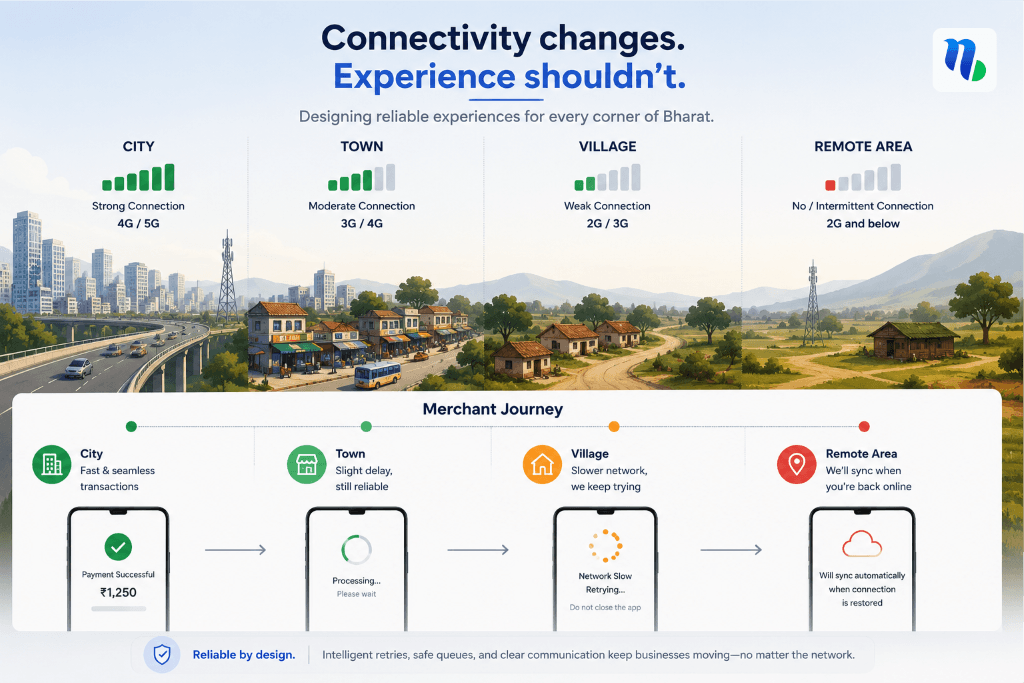
Designing for Resilience, Not Perfect Networks
Not every feature needs to work offline—but every feature should behave predictably when connectivity becomes unreliable.
This means designing applications that:
- Launch quickly on modest hardware.
- Exchange only the data they need.
- Resume interrupted uploads where appropriate.
- Retry network operations intelligently.
- Clearly communicate transaction status.
- Recover gracefully after temporary failures.
The objective is simple: reduce uncertainty without compromising financial integrity.
Clear Status Builds Transaction Trust
In financial services, uncertainty creates more friction than delay.
A merchant is often willing to wait a few extra seconds if they understand what the system is doing.
Simple messages such as:
- Processing…
- Awaiting bank confirmation…
- Network interrupted. Retrying…
- Payment successful.
These messages provide confidence and discourage duplicate transactions or unnecessary support requests.
Reliable communication is just as important as reliable infrastructure.
Building for an Unevenly Connected Future
Connectivity across India continues to improve, but designing for resilience will remain essential.
Future platforms will increasingly benefit from adaptive synchronization, edge-assisted content delivery, intelligent retry strategies, and lightweight Progressive Web Apps—all focused on delivering dependable experiences regardless of network conditions.